> For the complete documentation index, see [llms.txt](https://docs.roboflow.com/llms.txt). Markdown versions of documentation pages are available by appending `.md` to page URLs; this page is available as [Markdown](https://docs.roboflow.com/models/supported-models/depth-anything-v2.md).
# Depth Anything V2
Run the Depth Anything V2 monocular depth estimation API on a Dedicated Deployment or self-hosted Inference
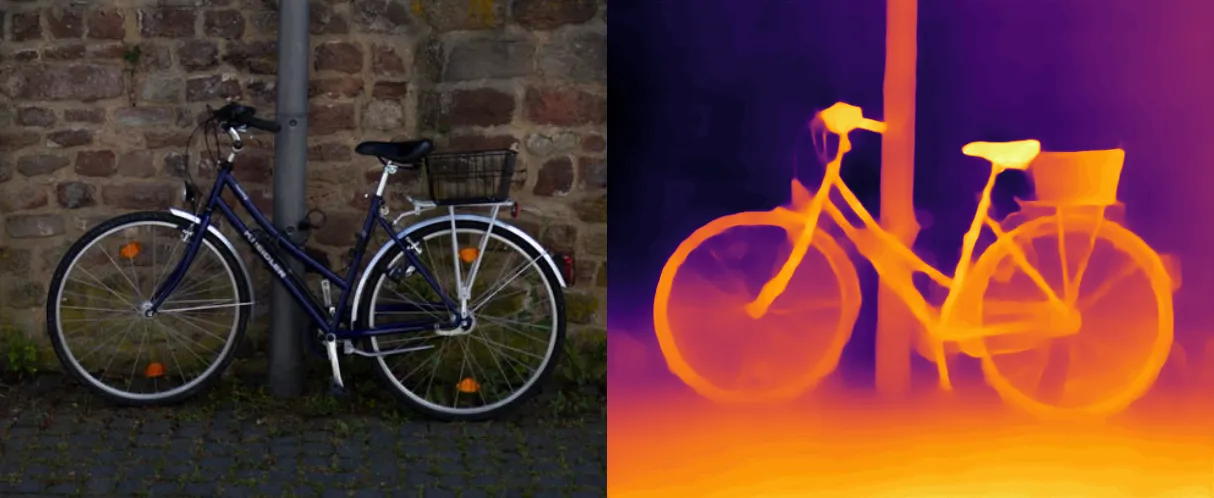
Depth Anything V2 is a monocular depth estimation model. It returns a normalized depth map (values between 0 and 1) for any input image.
{% hint style="info" %}
Depth Anything V2 is not available on the Serverless Cloud API. Run it on a [Dedicated Deployment](https://docs.roboflow.com/deployment/roboflow-cloud/dedicated-deployments) or [self-hosted Inference](https://docs.roboflow.com/deployment/self-hosted/self-hosted).
{% endhint %}
## Depth Anything V2 API
{% stepper %}
{% step %}
### Get your API Key
Create a Roboflow account, find your key on the [Roboflow API settings page](https://app.roboflow.com/settings/api) and make it available to your shell:
```bash
export ROBOFLOW_API_KEY="your-key-here"
```
{% endstep %}
{% step %}
### Install the dependencies
Install the [Inference SDK](https://docs.roboflow.com/deployment/self-hosted/self-hosted):
```bash
pip install -U inference-sdk opencv-python supervision
```
{% endstep %}
{% step %}
### Run the model
Set `api_url` to your Dedicated Deployment URL or a local Inference server. The script colorizes the depth map and writes a side-by-side comparison with the input.
```python
import os
import cv2
import numpy as np
import supervision as sv
from inference_sdk import InferenceHTTPClient, InferenceConfiguration
image = sv.load_image_from_url("https://media.roboflow.com/notebooks/examples/bicycle.png")
client = InferenceHTTPClient(
api_url="https://your-deployment.roboflow.cloud",
api_key=os.environ["ROBOFLOW_API_KEY"],
).configure(InferenceConfiguration(api_key_transport="header"))
result = client.depth_estimation(image)
depth = np.array(result["normalized_depth"], dtype=np.float32)
depth = cv2.resize(depth, (image.shape[1], image.shape[0]))
depth_vis = (depth * 255).astype(np.uint8)
depth_color = cv2.applyColorMap(depth_vis, cv2.COLORMAP_INFERNO)
cv2.imwrite("depth_annotated.png", np.hstack([image, depth_color]))
```
{% endstep %}
{% endstepper %}
## Depth Anything V2 inference speed
Latency measured with [Roboflow Inference](https://docs.roboflow.com/deployment/self-hosted/self-hosted) on 1x NVIDIA L4, batch size 1, mean after warmup.
Model
Latency (ms)
depth-anything-v2
40.1
Measured on the Small checkpoint.
{% hint style="info" %}
Set `api_url` to match your deployment target:
* `http://localhost:9001` for a local [Inference](https://docs.roboflow.com/deployment/self-hosted/self-hosted) server.
* Your [Dedicated Deployment](https://docs.roboflow.com/deployment/roboflow-cloud/dedicated-deployments) URL for a private endpoint.
{% endhint %}
## Depth Anything V2 available models
The depth estimation endpoint and the `depth_estimation@v1` Workflow block serve two model families behind one ordinal-depth contract: an image-sized map normalized per image, where `1.0` is nearest and `0.0` is farthest.
* **Depth Anything** (relative depth): `depth-anything-v2/small`, `depth-anything-v3/small`, `depth-anything-v3/base`
* **YOLO26 depth** (metric depth, normalized on this path, substantially faster): `yolo26n-depth-768`, `yolo26s-depth-768`, `yolo26m-depth-768`, `yolo26l-depth-768`, `yolo26x-depth-768`
The shared output preserves shape, range, and near-to-far ordering across models, but intermediate values are not geometrically equivalent between model families. Values are ordinal proximity scores, not physical distances, and must not be compared numerically across different images or model families. For absolute metric depth in meters from the YOLO26 checkpoints, load them directly with `inference_models.AutoModel`.
## Depth Anything V2 response formats
The `/infer/depth-estimation` endpoint serializes `normalized_depth` according to the request's `depth_map_format` field:
* `json` (default): a nested list of floats between 0 and 1. Wire-compatible with older clients, but roughly 17 MB for a 1080x810 image.
* `png16`: a base64 16-bit grayscale PNG (quantization step 1/65535, typically more than 10x smaller and much faster to serve).
* `png8`: a base64 8-bit grayscale PNG (256 depth levels, roughly another order of magnitude smaller). Fine for visualization and thresholding, lossy for derivative-based geometric use.
The SDK's `depth_estimation()` method defaults to `json`, so existing integrations keep receiving the nested list. Pass `depth_map_format="png16"` (or `"png8"`) to opt in to the compact payload: the SDK decodes it back into a `numpy.ndarray` (call `.tolist()` if you need JSON-serializable output).
{% hint style="warning" %}
The SDK's `json` default is deprecated. In one of the first Inference releases of 2027 the default switches to `png16` in a breaking way, and `normalized_depth` will then be returned as a `numpy.ndarray`. The SDK emits an `InferenceSDKDeprecationWarning` when the `json` format is used. Opt in to `png16` early, or pass `depth_map_format="json"` explicitly to keep the list format after the switch. Raw REST callers are unaffected: the server-side default stays `json`.
{% endhint %}
## Run Depth Anything V2 with self-hosted Inference
You can also load the model directly with the [`inference`](https://docs.roboflow.com/deployment/self-hosted/self-hosted) package.
{% stepper %}
{% step %}
### Install the package
```bash
pip install "inference[transformers]"
```
Use `inference-gpu[transformers]` on a GPU machine.
{% endstep %}
{% step %}
### Authenticate with Hugging Face
The weights are pulled from Hugging Face, so set a [Hugging Face token](https://huggingface.co/join):
```bash
export HUGGING_FACE_HUB_TOKEN=your_token_here
```
{% endstep %}
{% step %}
### Run the model
```python
from PIL import Image
from inference.models.depth_estimation.depthestimation import DepthEstimator
model = DepthEstimator()
image = Image.open("your_image.jpg")
results = model.predict(image)
depth_map = results[0]["normalized_depth"]
visualization = results[0]["image"]
```
`normalized_depth` holds the per-image depth map, and `image` holds a colorized visualization where lighter colors are nearer and darker colors are farther.
{% endstep %}
{% endstepper %}
### Execution modes in Workflows
When used in a [Workflow](https://docs.roboflow.com/workflows), depth estimation runs in one of two modes:
* **Local execution**: the model runs on your Inference server (GPU recommended).
* **Remote execution**: the model is invoked over HTTP on a remote Inference server through the `depth_estimation()` client method.