> For the complete documentation index, see [llms.txt](https://docs.roboflow.com/llms.txt). Markdown versions of documentation pages are available by appending `.md` to page URLs; this page is available as [Markdown](https://docs.roboflow.com/models/supported-models/owlv2.md).
# OWLv2
Run the OWLv2 one-shot object detection API on a Dedicated Deployment or self-hosted Inference
OWLv2 is Google's open-vocabulary object detector. You provide one or more example bounding boxes on a reference image, and OWLv2 detects similar objects in target images without any training.
{% hint style="info" %}
OWLv2 is not available on the Serverless Cloud API. Run it on a [Dedicated Deployment](https://docs.roboflow.com/deployment/roboflow-cloud/dedicated-deployments) or [self-hosted Inference](https://docs.roboflow.com/deployment/self-hosted/self-hosted).
{% endhint %}
## OWLv2 API
{% stepper %}
{% step %}
### Get your API Key
Create a Roboflow account, find your key on the [Roboflow API settings page](https://app.roboflow.com/settings/api) and make it available to your shell:
```bash
export ROBOFLOW_API_KEY="your-key-here"
```
{% endstep %}
{% step %}
### Install the dependencies
These packages call the API and draw its results:
```bash
pip install -U requests supervision opencv-python
```
{% endstep %}
{% step %}
### Run the model
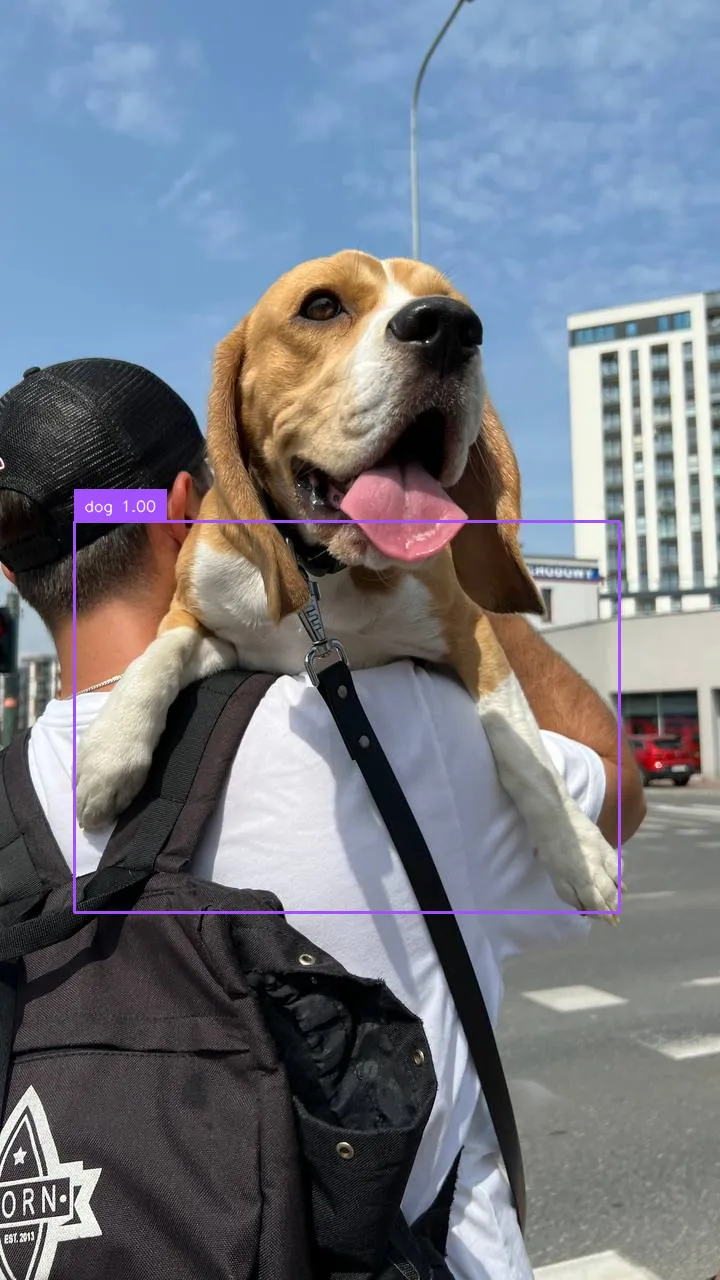
The sample below uses a single example box on the input image as the prompt and detects matching objects in the same image. In practice you typically pass a separate reference image. Set `URL` to your Dedicated Deployment URL or a local Inference server.
```python
import base64
import os
import cv2
import numpy as np
import requests
import supervision as sv
URL = "https://your-deployment.roboflow.cloud"
image = sv.load_image_from_url("https://media.roboflow.com/notebooks/examples/dog.jpeg")
_, buffer = cv2.imencode(".jpg", image)
image_base64 = base64.b64encode(buffer).decode("utf-8")
response = requests.post(
f"{URL}/owlv2/infer",
headers={"Authorization": f"Bearer {os.environ['ROBOFLOW_API_KEY']}"},
json={
"image": {"type": "base64", "value": image_base64},
"training_data": [{
"image": {"type": "base64", "value": image_base64},
"boxes": [{"x": 360, "y": 800, "w": 500, "h": 500, "cls": "dog"}],
}],
"confidence": 0.99,
},
)
preds = response.json()["predictions"]
xyxys = [
[p["x"] - p["width"] / 2, p["y"] - p["height"] / 2,
p["x"] + p["width"] / 2, p["y"] + p["height"] / 2]
for p in preds
]
detections = sv.Detections(
xyxy=np.array(xyxys, dtype=float),
class_id=np.array([p.get("class_id", 0) for p in preds]),
confidence=np.array([p["confidence"] for p in preds], dtype=float),
data={"class_name": np.array([p["class"] for p in preds])},
)
labels = [f"{p['class']} {p['confidence']:.2f}" for p in preds]
annotated = sv.BoxAnnotator().annotate(image.copy(), detections)
annotated = sv.LabelAnnotator().annotate(annotated, detections, labels=labels)
cv2.imwrite("dog_annotated.png", annotated)
```
{% endstep %}
{% endstepper %}
## OWLv2 inference speed
Latency measured with [Roboflow Inference](https://docs.roboflow.com/deployment/self-hosted/self-hosted) on 1x NVIDIA L4, batch size 1, mean after warmup.
Model
Latency (ms)
owlv2
541.2
Measured on the `owlv2-large-patch14-ensemble` checkpoint with two text prompts.
{% hint style="info" %}
Set `URL` to match your deployment target:
* `http://localhost:9001` for a local [Inference](https://docs.roboflow.com/deployment/self-hosted/self-hosted) server.
* Your [Dedicated Deployment](https://docs.roboflow.com/deployment/roboflow-cloud/dedicated-deployments) URL for a private endpoint.
{% endhint %}
OWLv2 confidences are typically very high (above 0.99). Tune the `confidence` parameter accordingly.
## Run OWLv2 with self-hosted Inference
OWLv2 can be loaded directly with the [`inference`](https://docs.roboflow.com/deployment/self-hosted/self-hosted) package. The implementation in Inference detects objects from *visual* examples: you box one or more example objects, and the model finds similar ones.
{% stepper %}
{% step %}
### Install the package
```bash
pip install "inference[transformers]"
```
Use `inference-gpu[transformers]` on a GPU machine.
{% endstep %}
{% step %}
### Run the model
```python
import base64
import io
from PIL import Image
from inference.core.entities.requests.owlv2 import OWLv2InferenceRequest
from inference.models.owlv2.owlv2 import OWLv2
image = {"type": "url", "value": "https://media.roboflow.com/inference/seawithdock.jpeg"}
request = OWLv2InferenceRequest(
image=image,
training_data=[
{
"image": image,
"boxes": [{"x": 223, "y": 306, "w": 40, "h": 226, "cls": "post"}],
}
],
visualize_predictions=True,
confidence=0.9999,
)
response = OWLv2().infer_from_request(request)
visualization = Image.open(io.BytesIO(response.visualization))
visualization.save("owlv2_visualization.jpg")
```
Replace `training_data` with the example objects you want to match, and the image URL with your own input. The annotated result is written to `owlv2_visualization.jpg`.
{% endstep %}
{% endstepper %}